
Works of Rudolf Steiner
- Phoenix Amata
- May 20, 2024
- 6 min read

Updated: May 31, 2024

________________________________________________________________________
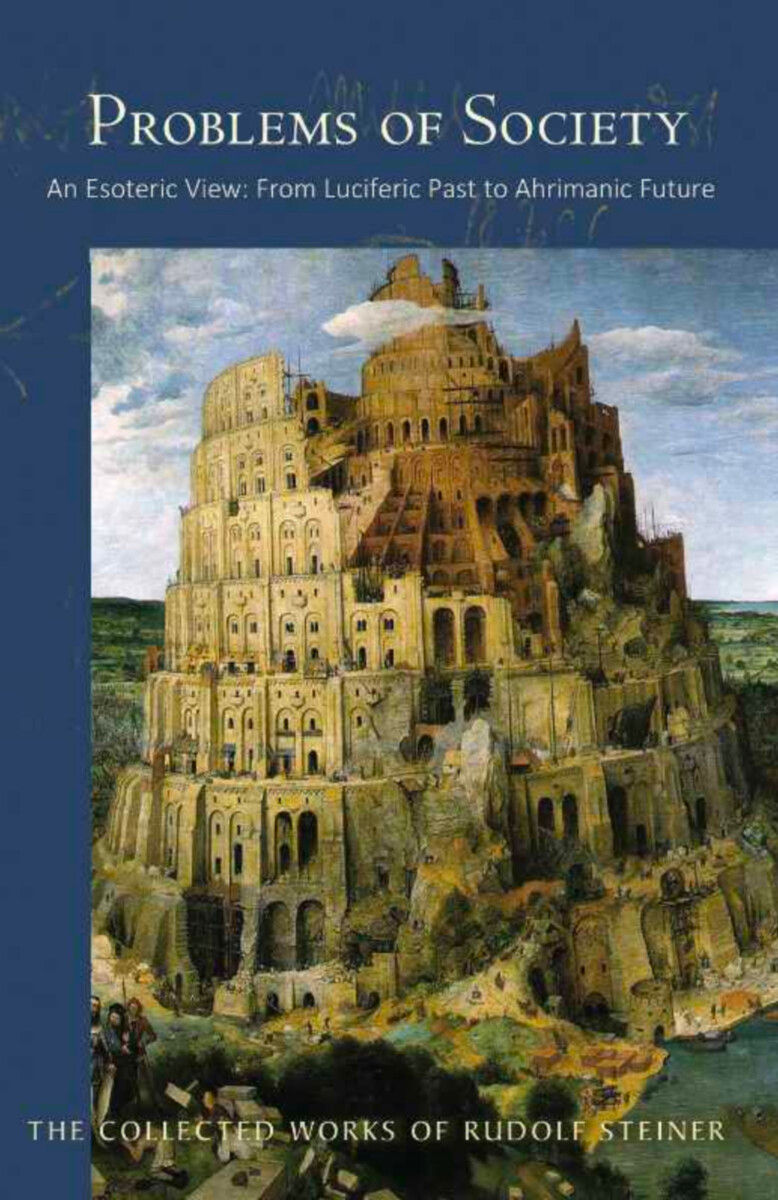
“Whatever turbulent outward events occur in the world, whatever form is taken by things seeking to work their way out of the depths of human evolution, we only really hearken to the true, underlying nature of these events...if we observe the world from a spiritual perspective” — Rudolf Steiner
In seeking to heal the many social crises of our time, Rudolf Steiner urges us to turn away from “fixed principles, theories, or social dogmas” and to rediscover the true nature of the human being. This inner reality—which cannot be understood in materialistic or deterministic ways—is the only basis on which society can be truly founded. Nevertheless, Steiner tells us that it is not enough to speak of well-meaning ideas, unless we also actively work for change—change that begins with each of us.
In 1919, a year marked by strong social and political upheavals, Steiner was deeply concerned with social questions. Having published a book on the subject (Towards Social Renewal), he embarked on a major campaign to publicize his “threefold” ideas for society. In addition to public lectures, however, Steiner also sought to deepen the subject in a series of talks to members of the Anthroposophical Society. Those lectures, gathered in this volume, reveal the “inner,” or “esoteric,” aspects of the social question. They complement Steiner’s very practical efforts to realize threefolding in the historical context of his time.
Whereas Steiner’s suggestions for social change may seem counter-intuitive to pragmatic thinkers, they will strike a resonant chord in many of those who seek deeper answers to the social problems of our time—problems that politicians seem unable to remedy. Among the many themes that Rudolf Steiner discusses here are nationalism as a retrograde tendency; the tasks of Central Europe and Britain in relation to the East; the incarnation of Ahriman in the West, and the historical incarnation of Lucifer in the third millennium BC.
“Time and again in these lectures, Steiner urges us to turn away from ‘fixed principles, theories, or social dogmas,” appealing instead to the intrinsic nature of the human being as the only reality on which society can be founded.” — Matthew Barton
This volume is a complete translation from German of Der innere Aspekt des sozialen Rätsels. Luziferische Vergangenheit und ahrimanische Zukunft (GA 193). Four lectures appeared previously as The Esoteric Aspect of the Social Question: The Individual and Society.
______________________________________________________________________
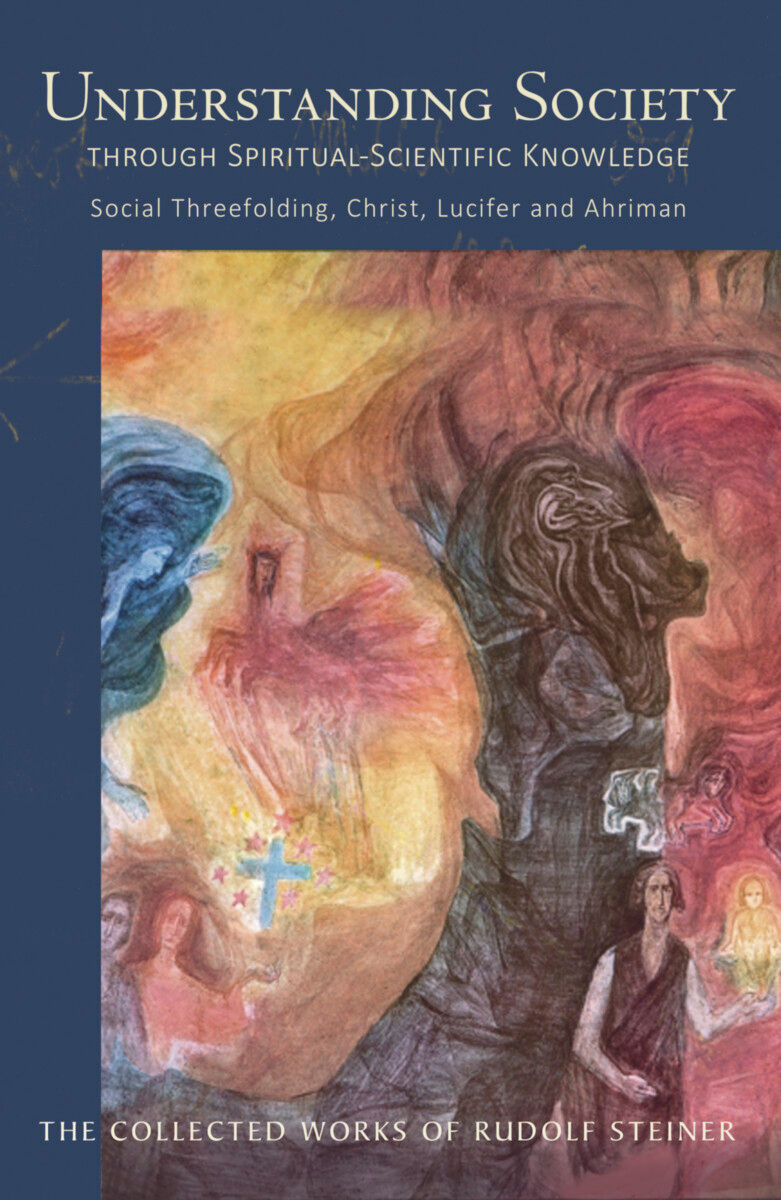
“The spirit of cold divisiveness and isolationism, of unsympathetic feeling and enmity, of action either immobilized or excessively violent, is clearly incarnating amongst us. But Steiner offers us remedies, and in an insight of real genius, instead of dogmatically castigating the coldness of science or of self-referential voluptuousness of our subjective feelings, he proposes a beautiful reversal: to regard ourselves and our subjectivities with scientific objectivity, and to observe the outer world and its phenomena with all the subjective warmth of our keenest interest. For me, this has all the persuasive depth, simplicity, and difficulty of a true way forward.” — Matthew Barton (from his introduction)
In the uncertainty following World War I, Rudolf Steiner perceived a unique opportunity to establish a healthy social and political constitution. He began lecturing throughout post-war Germany, often to large audiences, about his social ideas. Here, speaking to a more intimate grouping at the Goetheanum in Dornach, Switzerland, Steiner seeks to deepen the themes of social threefolding, showing specifically how new social thinking is integral to Anthroposophy.
Steiner speaks about the superficiality of a materialistic view of history, originating with the economic shift among the population at the time of the Reformation. During the Egypto–Chaldean era, initiates ruled from spiritual impulses. Later, in the Greco-Roman period, priests held power over their congregations. Today, homo economicus (the economic human) has become the dominant idea as capitalists and bankers assume control. However, healing social relationships can be done only through a different mode of thinking—the life of spirit must be separated not only from politics but also from economics. True social understanding allows our comprehension of karma and appreciation of each individual's personal destiny. In the meantime, Steiner tells us, we should work toward global consciousness, as true social ideas are based on people's feeling that they are citizens of the world.
In an important corollary, in these lectures Steiner investigates the incarnations of three significant spiritual beings in human evolution—Lucifer, Christ, and Ahriman. Lucifer incarnated during the third pre-Christian millennium; Christ incarnated at the dawn of a new age; today, an incarnation of Ahriman in the West is immanent. Ahriman is preparing this incarnation by insidiously promoting certain ideas—in particular, that economic security is sufficient for healthy public life. Fresh wisdom must be achieved through free human will, says Steiner; otherwise, we will succumb to Ahriman.
This volume is a translation from German of Soziales Verstandnis aus geisteswissenschaftlichen Erkentnis Die Geistige Hintergründe der Sozialen Frage - Band III (GA 191)
_________________________________________________________________________

“Rudolf Steiner’s perspectives on technology are manifold and prophetic. He not only critiqued the technology of his day, but foretold new forms of technology that would inevitably arise, technologies that would be connected to the makers’ very attitudes of soul, either the good or bad within them—in other words, their deepest motivations. How we, as evolving human beings, approach technology and its development will be instrumental in determining how ultimately human evolution will turn out. Our future as human beings and the future of technology are intimately connected.” — Gary Lamb
Illuminating, compelling, challenging, at times staggering in its breadth, A Road to Sacred Creation is above all the definitive text for gaining a hold on Rudolf Steiner’s nuanced perspectives on technology. Charting both an inner and outer course—part pilgrimage toward greater perception and knowledge, part dramatic, unfolding plot line of the future of humans and machines, the metaphoric “road” of the title is exactly where humanity finds itself today, though the exact route and destination are still to be determined. The map is not yet drawn, but here is a beginning.
Taken together, the relevant concepts, ideas, and insights of Steiner—deftly brought into sequence and dialogue as the editor has done in this book—reveal how the work to arrive at a more spiritually imbued technological future not only involves all domains and fields of spiritual science and anthroposophic work, but has its origins in the very core of our being, fundamentally entwined with our moral progress toward freedom and selfless love.
____________________________________________________________________________

7 lectures (of 9), St. Gallen, Zurich, and Dornach, Nov. 6–25, 1917 (CW 178)
“This is a stark and extremely challenging group of lectures, given at a decisive time of tremendous crisis for humanity and dealing with themes that stretch from 1917 back into the distant past as well as into the far future.” — Terry Boardman (the introduction)
In the age of the internet and the proliferation of “conspiracy theories,” ideas that secret groups are trying to gain control of humanity are no longer rare. But this was not true in 1917 when Rudolf Steiner spoke of such matters in the extraordinary lectures contained in this book. His unique contribution to this controversial topic is not based on abstract theories; it arose from exact research methods that use advanced forms of perception and cognition.
Using the firsthand knowledge available to him, Steiner takes us behind the scenes of events in outer history and contemporary culture to reveal a dark world of secret elitist brotherhoods that are attempting to control the masses through the forces of economics, technology, and political assassinations. These hidden groups, he explains, seek power through the use of ritual magic and suggestion.
Never before available in English as a complete volume, the text of this book has been freshly translated for this edition.
Secret Brotherhoods is a translation of 7 lectures from German of Individuelle Geistwesen und ihr Wirken in der Seele des Menschen. Geistige Wesen und Ihre Wirkung Band II (GA 178).
______________________________________________________________________________

A compilation of lectures
"Large temptations will emanate from these machine-animals, produced by people themselves, and it will be the task of a spiritual science that explores the cosmos to ensure all these temptations do not exert any damaging influence on human beings." — Rudolf Steiner
In an increasingly digitized world, where both work and play are more and more taking place online and via screens, Rudolf Steiner’s dramatic statements from 1917 appear prophetic. Speaking of "intelligent machines" that would appear in the future, Steiner presents a broad context that illustrates the multitude of challenges human beings will face. If humanity and the Earth are to continue to evolve together with the cosmos, and not be cut off from it entirely, we will need to work consciously and spiritually to create a counterweight to such phenomena.
In the lectures gathered here, edited with commentary and notes by Andreas Neider, Rudolf Steiner addresses a topic that he was never to speak of again—the secret of the geographical, or ahrimanic, Doppelgänger. The human nervous system houses an entity that does not belong to its constitution, he states. This is an ahrimanic being that enters the body shortly before birth and leaves at death, providing the basis for all electrical currents needed to process and coordinate sensory perceptions and react to them.
Based on his spiritual research, Steiner discusses this Doppelgänger, or double, in the wider context of historic occult events relating to spirits of darkness. Specific brotherhoods seek to keep such knowledge to themselves to exert power and spread materialism. But this knowledge is critical, says Steiner, if the geographical Doppelgänger and its challenges are to be understood.
Originally published in German as Der Electronische Doppelgänger (Rudolf Steiner Verlag, 2013).
________________________________________________________________________


Comments