
Resources Pertaining to P.D. Ouspensky
- Phoenix Amata
- Sep 15, 2024
- 3 min read


Research Note: Ouspensky and the Eternal Return:
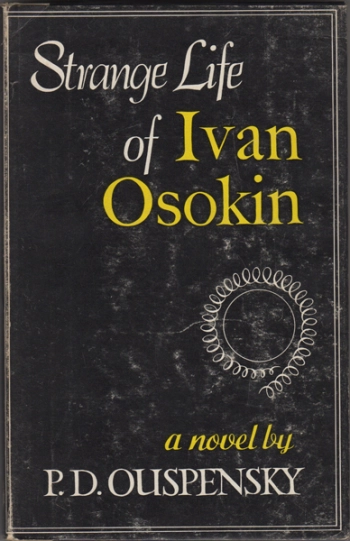
Russian esotericist P. D. Ouspensky (1878–1947) believed in the literal truth of eternal recurrence. As a child, he had been prone to vivid sensations of déjà vu, (1) and when he encountered the theory of eternal return in the writings of Nietzsche, it occurred to him that this was a possible explanation for his experiences. (2) He subsequently explored the idea in his semi-autobiographical novel, Strange Life of Ivan Osokin.
In this story, Ivan Osokin implores a magician to send him back to his childhood and give him the chance to live his life over again. The magician obliges, but warns Ivan that he will be unable to correct any of his mistakes. This turns out to be the case; although Ivan always knows in advance what the outcome of his actions will be, he is unable to keep himself from repeating those actions. Having re-lived his life up to the point of his conversation with the magician, Ivan asks in despair whether there is any way of changing the past. The magician answers that he must first change himself; if he works on improving his character, he may have a chance of making better decisions next time around.
The earliest version of the novel, however, did not include the magician,[3] and ended on "a totally pessimistic note".[4] The revolution in Ouspensky's thoughts on recurrence – the idea that change is possible – took place after he became a disciple of the mystic George Gurdjieff, who taught that a person could achieve a higher state of consciousness through a system of strict self-discipline. When Ouspensky asked about eternal recurrence, Gurdjieff told him:[5]
This idea of repetition ... is not the full and absolute truth, but it is the nearest possible approximation of the truth ... And if you understand why I do not speak of this, you will be still nearer to it. What is the use of a man knowing about recurrence if he is not conscious of it and if he himself does not change? ... Knowledge about the repetition of lives will add nothing for a man ... if he does not strive to change himself in order to escape this repetition. But if he changes something essential in himself, that is, if he attains something, this cannot be lost.
Ouspensky incorporated this idea into his later writings. In A New Model of the Universe, he argued against Nietzsche's proof of the mathematical necessity of eternal repetition, claiming that a large enough quantity of matter would be capable of an infinite number of possible combinations. According to Ouspensky, everyone is reborn again into the same life at the moment of their death, and many people will indeed continue to live the exact same lives for eternity, but it is also possible to break the cycle and enter into a new plane of existence.[6]
Notes:
(1) Webb, James (1980). The Harmonious Circle. J. P. Putnam's Sons. p. 96. ISBN 0-399-11465-3
(2) Wilson, Colin (2005). The Strange Life of P. D. Ouspensky. Aeon Books. p. 13. ISBN 1-904658-25-3.
(3) Webb, James (1980)
(4) Wilson 2005, p. 73
(5) Ouspensky, P. D. (1950). In Search of the Miraculous. Routledge and Kegan Paul Limited. p. 250.
(6) Ouspensky, P. D. (1938). "Eternal Recurrence and the Laws of Manu". A New Model of the Universe (3rd ed.). Routledge and Kegan Paul Limited. pp. 464–513.
______________________________________________________________________________





Comments